Thursday, April 21, 2011

The Pros (and Cons) of Prose

Style matters. It's one of the first tenets you'll find in pretty much any book on professional writing. Lately, I've been finding myself comparing and analyzing the writing styles of authors I enjoy. Part of it has to do with trying to pin down my own natural style which is in a near constant state of flux, and the other part has to do with simple curiosity. How do published, successful authors do what they do, and so well?

It seems there's a versatility in fiction, as in music and art, that encourages new and varying styles of writing. This benefits the reader who will have lots to choose from, but can baffle the writer who's trying to figure out what works and identify their place in the literary universe.

I'll give you an example of what I mean.

I'm currently in the process of reading Outlander by Diana Gabaldon. It's a genre buster, involving romance and fantasy and history, all wrapped into a nice, little package. Or not so little, considering it's roughly 850 pages long (considering the version you buy). It's chock full of description -- from the changing locations to the characters, even minor ones, nothing escapes the detailed treatment.
I swung down the road that afternoon toward the village to fetch Frank from the vicarage. I happily breathed in the heady Highland mix of heather, sage, and broom, spiced here and there with chimney smoke and the tang of fried herring, as I passed the scattered cottages. The village lay nestled in a small declivity at the foot of one of those soaring crags that rise so steeply from the Highland moors. Those cottages near the road were nice. The bloom of postwar prosperity spread as far as a new coat of paint, and even the manse, which must be at least a hundred years old, sported bright yellow trim around its sagging windowframes. - Outlander, page 28
Beautiful prose, no? And it's consistently awe-inspiring throughout the novel, too. If there was ever a book to teach how to describe people and places in fiction, I would definitely recommend this one.

And in the other corner . . . I just finished reading Anna and the French Kiss by Stephanie Perkins. It's a Young Adult romance with genuine charm and humor. Honestly I could sing praises up and down for it. As expected, its written more simply than Outlander, but manages to highlight important details just the same.
He shakes his head, a little dazed. The first thing I notice is his hair -- it's the first thing I notice about everyone. It's dark brown and messy and somehow both long and short at the same time. I think of the Beatles, since I've just seen them in Meredith's room. It's artist hair. Musician hair. I-pretend-I-don't-care-but-I-really-do hair.
Beautiful hair.
[. . .]
The beautiful boy gives an amused grin. His teeth are lovely-straight on top, crooked on the bottom, with a touch of overbite. I'm a sucker for smiles like this, due to my own lack of orthodontia. I have a gap between my front teeth the size of a raisin. - Anna and the French Kiss, pages 15/16
Both books are well-written, without a doubt. They both have their strengths, as well as their weaknesses. My point is, they both have such different styles. Of course, they're in different genres and age ranges, but the fact is both succeed at what they're setting out to do. Entertain.

I adore the English language, so my style tends to shy towards arguably excessive description, usually with a large focus on character introspection, and it's always made me curious whether people care for all of that or if they're secretly skimming to the dialogue.

Orrrr, maybe I'm just paranoid. *shifty eyes*

Inquiring minds would like to know, dear readers! What sort of style of writing do you prefer to read? What kind do you like to write? Are there certain circumstances in which a simpler approach to prose is better?

Sunday, April 17, 2011

History Will be Kind to Me for I Intend to Write It

So I'm a history major now.

Crazy, right? For most of my life, it was practically a foregone conclusion that -- if I chose to go to college at all -- I would end up an English major. Creative writing's my thing, has been since I first started with Johnny Quest fanfiction in the first grade, and I'm not too bad at essays either. Reading the assigned literature, on the other hand . . . well, I plead the fifth. No offense, Dickens.

It began to occur to me that my interests were not so linear anymore. When perusing classes, I kept being drawn back to history courses. All I could think of was, what stories these classes could tell me, what inspiration would I draw from the past! For me, that's what history is: tales of real people living real lives. People just like you or me -- women and men who had dreams and hopes and fears. Not just names in a textbook (that I'm required to read and probably won't because we've established this sad truth). They say life is stranger than fiction, and many events that have taken place in the course of human history are certainly strange, to say the least, if not outright unbelievable!

I still wanted to be an author, of course, but I was no longer certain than an English degree was the best or, I should say, only way to help me achieve that. Don't get me wrong, I think an English degree is wonderful, and immensely helpful for any would-be writer. It just wasn't for me, after all. And I'll be entering my third year next fall, so this could change, but right now I'm happy with the decision to become a history major.

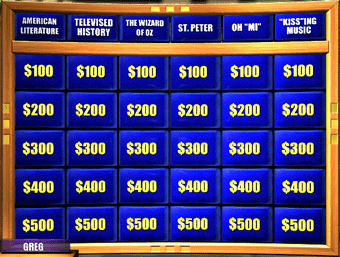
I've already started watching Jeopardy; that's like halfway there, right? ;)

Thing is, writers are incredibly fortunate as they can study 'at the knee', proverbially speaking, of the masters. All the greats that came before us have left their life's work for us to read and learn from. I didn't need an English degree for that, not when I could pick up any of those books on my own time (and with the added bonus of not having to write a lengthy essay about symbolism). The truth of the matter was, a minor in creative writing would give me everything I needed, leaving me free to choose whatever major I wanted and investigate a different path than the one initially marked out in crayon by my younger self.

It was both thrilling and terrifying -- but what big changes in life aren't?

I've always felt that pursuing your passions is important. If you don't like where you're at, why are you there? If you don't like what you're doing, why are you doing it? I'm as guilty of getting caught up in routine as anyone else. Because it's safe. Because it's easy. But rarely is it as rewarding as stepping from your comfort zone, taking a chance, and diving into something new, just for the heck of it.

The Roman writer, Virgil, famously wrote, "Fortune favors the bold."

So be bold, in your writing and in life!

Note: Blog post title is a quote by the ever-excellent Winston Churchill.

Saturday, December 25, 2010

Merry Christmas!

Merry Christmas, all! Hope your day is a wonderful one, spent amongst family and friends!

Love,
Hayley


Also, I will leave you with one of my favorite Christmas songs, by none other than the King, Mr. Elvis Presley:


Thursday, November 11, 2010

They're More Like Guidelines Than Actual Rules

And that's the second Pirates of the Caribbean quote I've used for the title of a blog post. *nerd points*

So since we're in the midst of NaNoWriMo, and writers everywhere are trying to lure their weeping muses out from the bathroom with promises of double fudge rocky road and no more sentences ending in prepositions, I thought I'd share some of the techniques that I've learned over the years.

#1. Start strong. The first sentence, to me, is probably the most important sentence you will write in the whole novel, except for maybe the last one. It's the hook, the thing that draws the reader in and invites them to stay awhile. When you pick up a book at the store, chances are you pop it open and read the first sentence or three just to get a taste. 

For me, I like to think of the opening sentence and paragraph as the foundation for everything else that is to come. Get this right, tweak it as much as you need to until you're happy with it, and then move on. The strongest house will falter on a weak foundation, and the same goes with a novel; so make sure that beginning is tight. Once you're confident and content with it, everything else will come much easier. You'll be safe in the knowledge that you have a solid beginning with which to fall back on if you ever stray too far from the story you're trying to tell.

You may lather, rinse, repeat for the beginning of each chapter afterwards. The same idea applies.*

#2. Set the mood. I've mentioned this in a previous blog post, but music, more than anything else, can be a helpful tool in seducing your muse. If you're writing an action scene, why not pick some heavy rock n' roll? The fast tempo will get your heart racing, matching the hectic rhythm of an action sequence. How about a quiet ballad for a scene between two lovers? Lyrics may inspire dialogue. If nothing else, music will help you envision the scene that you're writing. I like to imagine it like a soundtrack and the movie is your novel.

#3. Eliminate distractions. This could also be called 'disconnecting your internet'. The internet, while extremely useful, is also extremely distracting. If you find yourself on Facebook or Twitter after every other word, then maybe it's time for some drastic measures -- such as unhooking your internet cable or turning off the wifi for a little while. I must confess, I'm as guilty of this as anyone, but discipline comes with practice! 

And, besides, the world won't end if you don't check your email every other minute. Well, unless you work for Skynet or something. In which case, you should stop working on that T-600 prototype altogether and pursue your dreams of becoming an author. It'll be better for the whole human race, trust me.

#4. Take a break. If absolutely nothing is working and you've begun contemplating throwing your PC/Mac/Typerwriter out the window, then maybe it's time to take a break and come back to it in a bit. Many people have suggested exercise as a good way to get the creative juices flowing, and I agree. Plus, it's healthy, always a nice bonus! Your body and mind will thank you.

But seeing as I'm rather lazy, I also have an alternative to provide! Watch a movie or read a book, any form of narrative that relates to the genre that you're writing. Writers are fortunate because we can study at the knee of the master any time we'd like -- we just have to crack open a book, or pay attention to the script of a movie. Sometimes it helps to see how another author has managed to get through a fight scene, or weave together several seemingly unrelated subplots. You don't even have to be consciously thinking about all of this. Your brain is awesome and will work through the writer's block by itself, given the time. So don't give up!

There's also the option of sleep. Dreams can be inspiring. And a rested brain works much better than a frazzled, overworked one.

#5. Just write. It might seem obvious, but the best way to get a novel done is to just write it. One word after the other. Push through the self-doubt and the nagging of your inner editor. One of the best ways to do this is to remind yourself of the good writing that you have done, thus far. There's bound to be a sentence somewhere that you're proud of writing. And there will be more, so long as you keep going!

Hopefully some of these tips help you! In the end, different things work for different writers. The only rule in this game is: whatever works, works. And don't forget to have fun along the way!

That being said, I'm rooting for all of you, dear writers! Feel free to share some of the tips and tricks that you've learned to help you on the bumpy road that is writing a novel. =)


* Disclaimer! Don't get hung up on the beginning, however. If you just can't get it the way you want it, and it's dragging you down, sometimes it's better to move on to the meat of your story and come back later. Writing something is better than giving up and writing nothing! Never surrender!